

Inside the craft
How a fireworks shell is made by hand
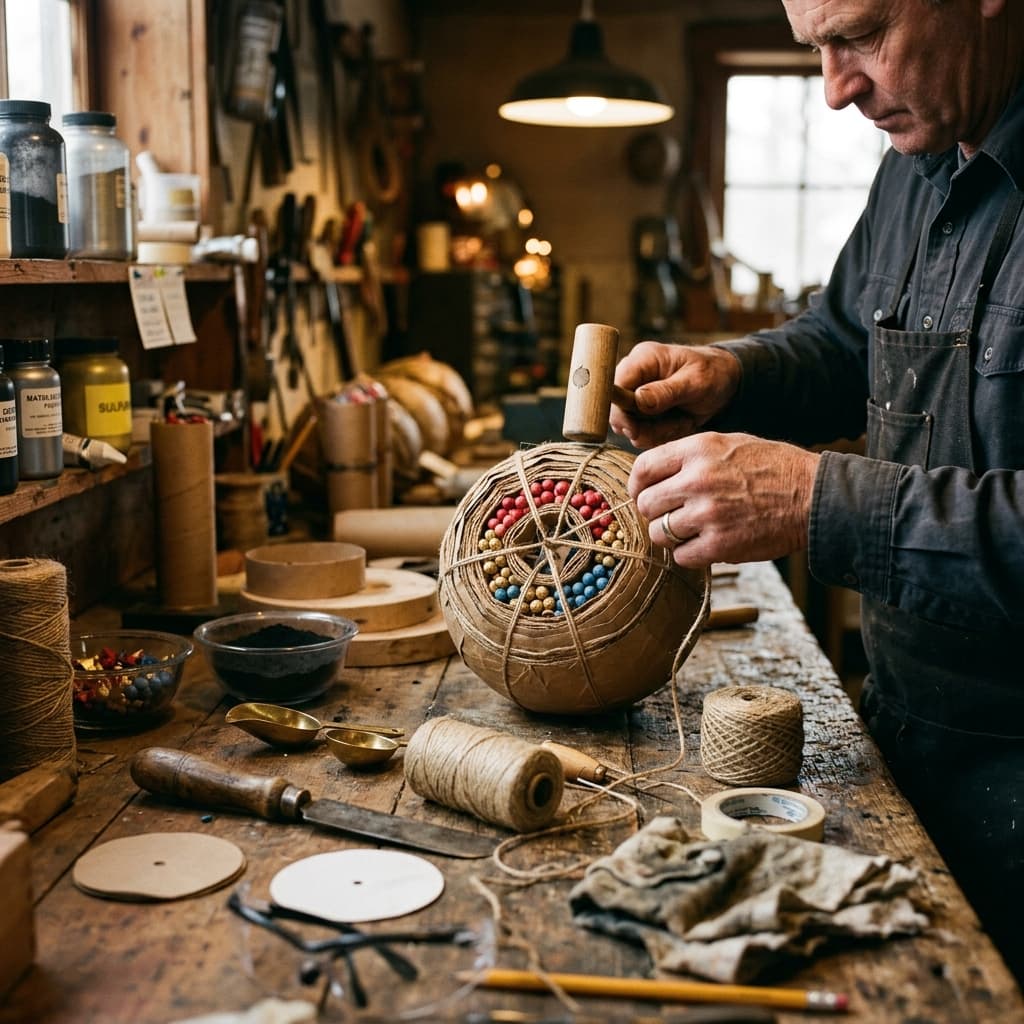
Every shell that blooms over a fiesta or a Media Noche crowd starts out as paper, powder, and string on a workbench. In our family's workshop in Bigaa, Cabuyao, Laguna, we have been building aerial shells largely by hand since 1948. Here is what goes into one, and why the picture in the sky is decided long before anyone lights a fuse.
What's inside a traditional aerial shell?
Strip away the wrapping and a shell is five parts, each with one job:
- Casing — a strong paper sphere that holds everything in place and keeps its shape on the way up.
- Stars — small pellets of pyrotechnic composition; each one becomes a single dot of light in the sky.
- Burst charge — a black powder core that breaks the shell open high in the air and lights the stars.
- Lift charge — black powder at the base of the shell that launches it out of its mortar tube.
- Time fuse — a slow-burning cord, lit at the moment of launch, that decides exactly when the shell opens.
How fireworks stars are mixed and rolled
A star is a pellet about the size of a pea or a marble. Inside it are four things: an oxidizer to supply oxygen, a fuel to burn, a metal salt that gives the flame its color, and a binder to hold the pellet together.
We make stars two ways. Rolled stars begin as a tiny core tumbling in a drum while we wet it and dust on fresh composition, layer over layer, the way a pearl grows. Slow work, but it gives a round, even-burning star. Cut stars start as a damp dough that is pressed flat and sliced into small cubes. They are quicker to make, and right for effects that don't need a perfect sphere.
Some shells carry stars built in layers, so the bloom changes color as it spreads.
Why fireworks make different shapes in the sky
The part most people never guess: the shape you see overhead is packed into the shell by hand, star by star.
- Spread the stars evenly around the inside of the sphere, and the burst opens as a round ball of light — a peony, or a chrysanthemum when the stars leave glowing trails like petals.
- Use stars that burn long and keep glowing as they fall, and you get a willow: golden branches drooping toward the ground.
- Pack stars that each split into smaller pieces midair, and you get a crossette: little bursts that crisscross.
- A few thick, heavy streams make the rising fronds of a palm; dense glitter that lingers overhead makes a kamuro.
Stars glued in an outline, like a ring or a heart, appear as that same outline overhead. Every effect we fire was first arranged on a workbench. You can see the shapes we make in-house on our products page.
The time fuse: the difference between a flower and a dud
When the lift charge fires, it does two jobs at once: it throws the shell out of the mortar and lights the time fuse. The fuse is cut and fitted so the shell opens near the top of its flight. For a large shell, that is roughly 200 meters up.
Get the timing wrong and everything else is wasted. A fuse that burns too fast opens the shell low, which is dangerous. One that burns too slow, or goes out, gives you a dud. Fusing goes to our most experienced hands, and every shell is checked again before it reaches a show — the same discipline behind how professional displays are kept safe.
Drying, the step nobody can rush
Between every step, there is waiting. Stars must dry slowly and completely; so must finished shells. A damp star burns dim, drifts off-color, or refuses to light at all. In Laguna's humid air, rushing this stage is the easiest way to ruin weeks of work.
So we wait, turn the trays, and check by hand: weight, feel, even sound. Experienced fingers can tell when a batch needs one more day.
Why we still make shells by hand in Cabuyao
Our family has made fireworks in Bigaa, Cabuyao since 1948. That is more than 75 years, with Vincent B. Lebrilla leading the workshop today. Machines mix and press faster than people do, and we use them where they help. But a machine cannot feel a damp star, notice a casing wound slightly loose, or judge whether a willow star will hang long enough in the air.
Hand work is how we keep every chrysanthemum round and every kamuro falling the way the last one did. The same consistency went with us to Vancouver in 2023, when our team fired the winning show for Team Philippines at the Honda Celebration of Light. The show won both the Champion and People's Choice awards.
If you are curious what each of these effects looks like in flight, browse the shells we build on our products page. And if there is a fiesta, debut, or countdown on your calendar, tell us about it. We reply within one working day, and we would be glad to put 75 years of hand work over your sky.
Fireworks questions are our favorite kind. If this guide left you wondering about your own event, venue, or budget, send it our way — advice is free.
Plan a displayKeep reading more from the journal
 Inside the craftHow fireworks get their colors (and why blue is the hardest)Every firework color comes from a metal: strontium burns red, barium green, copper blue. How heat makes atoms glow — and why a true blue is the rarest sight.Read this
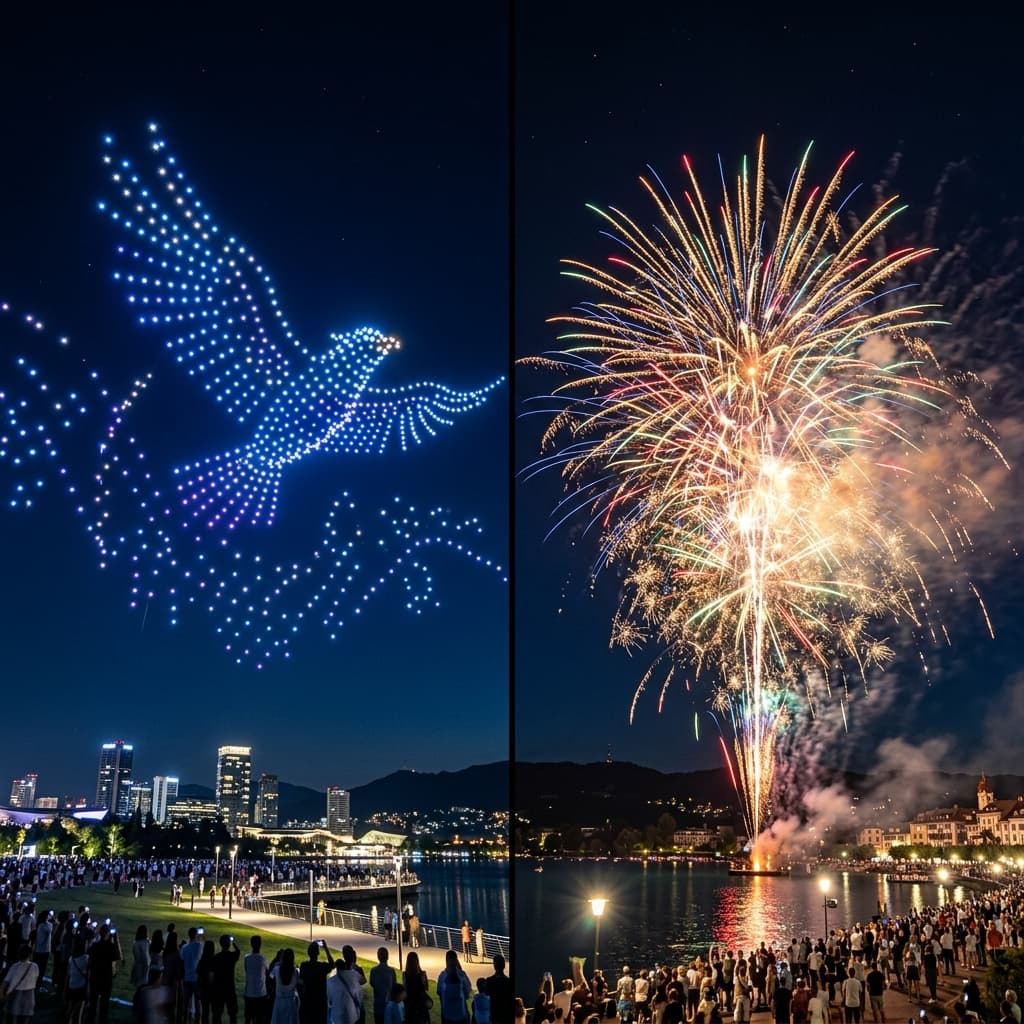 Event guidesDrone light show or fireworks display: which fits your event?We stage both drone light shows and fireworks. An honest comparison of sound, venues, weather, animals, and storytelling to help you pick the right one.Read this
 Event guidesWhat is a pyromusical? Fireworks that follow the musicHow computer-fired fireworks sync to a soundtrack, what music works best, and what it takes to bring a pyromusical to your own event.Read this